


.svg)
.svg)
Contents
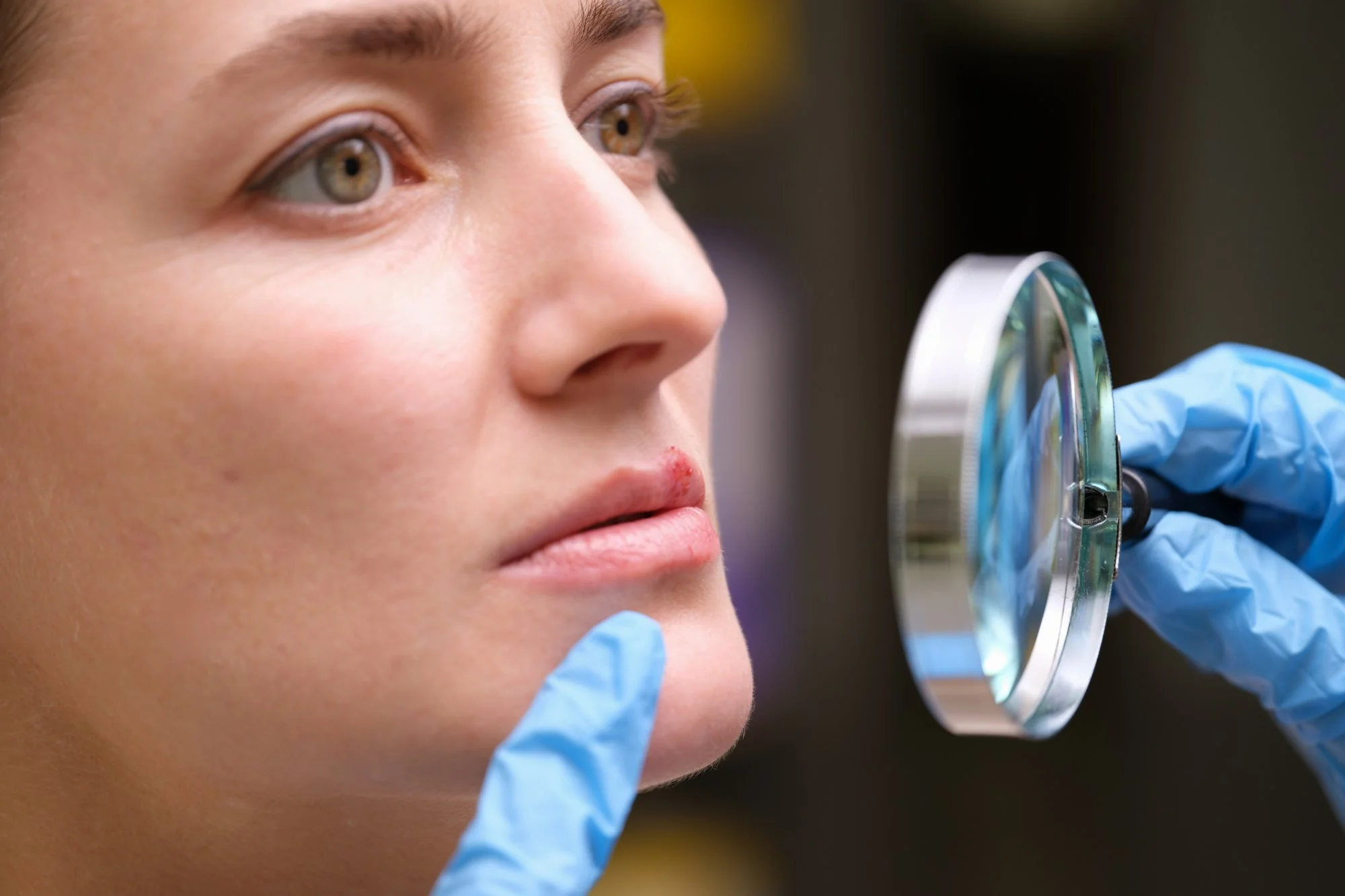
Going to the dentist with an active cold sore is usually something to postpone rather than push through. For routine care such as a cleaning, a filling, or whitening, most offices will ask you to reschedule until the lesion has healed. For genuine urgency, such as severe pain, swelling, or trauma, treatment generally still goes ahead, with extra precautions.
That distinction is not about squeamishness, and it is not a judgment about your hygiene. A cold sore is an active viral infection at the exact spot the dental team needs to work, and the equipment used in a dental operatory is very good at moving small droplets around a room. Postponing an hour-long cleaning is a much smaller cost than the alternatives.
This article explains why that recommendation exists and what it means for your appointment. If you are dealing with pain, swelling, or a broken tooth right now and also have a cold sore, call the office rather than waiting, and see our emergency dentistry page.
What a Cold Sore Actually Is
A cold sore, also called herpes labialis, is a recurrence of herpes simplex virus type 1 (HSV-1). Estimates vary, but roughly 85% of the US population carries HSV-1, and most people acquire it in childhood or adolescence rather than through anything that happened recently. There are more than 100 million episodes of herpes labialis in the United States each year.
After the first infection, the virus does not leave. It travels along a sensory nerve and goes dormant in the nerve cell body. A trigger such as strong ultraviolet light or a feverish illness can reactivate it, and the virus travels back down the same nerve to the skin. That is why recurrences tend to appear in the same place every time.
About 40% of infected people get visible recurrences. The rest appear to clear reactivations before a lesion ever forms, which suggests that people who get repeated cold sores may simply have a weaker cell-mediated response to this particular virus. Frequent cold sores are not a sign of poor hygiene.
The Stages of a Cold Sore, and Why They Matter
A cold sore follows a predictable sequence: a prodrome of tingling, itching, or burning before anything is visible, then a raised papule, then a fluid-filled vesicle, then an open lesion, then a soft scab and a hard scab as it heals. Left untreated, the whole cycle usually resolves in 10 to 14 days.
Those stages matter because infectiousness is not constant across them. Viral counts are highest while the lesion is open, and higher still if it is weeping. The first few days are the most contagious. A dry, hard scab that is nearly gone is a very different situation from a blister that broke this morning, and a reasonable office will treat those two differently.
Why Your Dentist May Ask You to Reschedule
There are three separate concerns here, and they do not all point at the same person. One is the risk to you, one is the risk to the dental team, and one is the risk to your lesion healing normally. Understanding all three makes the recommendation easier to accept, and easier to plan around.
Risk One: Spreading the Virus to Your Own Eyes or Fingers
HSV-1 does not only affect the lips. It can infect the skin of the hands and fingers, where it is called herpetic whitlow, and it can infect the cornea, where it is called herpetic keratitis. Eye infection most often happens when someone with an active lip lesion touches or rubs their eyes.
Having had an oral infection does not protect you from acquiring the virus somewhere else on your own body. That matters during a dental appointment, because a long visit with your mouth open, your face being handled, and your hands idle is exactly the setting in which people rub an eye without thinking about it.
Risk Two: Aerosols in the Operatory
Dental equipment generates a fine aerosol of saliva and water. The largest producers are the ultrasonic scaler, the handpiece, and the air polisher, in that order. When the source of that aerosol is a mouth with an active herpetic lesion, the aerosol can carry virus with it into the air of the room.
University health guidance makes the same point in plainer terms: aerosol-generating equipment can carry the virus to other areas, including the eyes during dental treatment. This is a genuine gap in standard protection. Ordinary safety glasses, even with side shields, are designed to stop spray and larger droplets, and they are much less useful against a fine aerosol that can travel around the edges. Infection control guidance in dentistry was built largely around bloodborne viruses, which behave very differently from a highly transmissible surface virus like HSV-1.
It is also worth knowing that HSV-1 has been detected in the saliva of people with no symptoms at all. That is one reason dental offices use protective equipment with every patient rather than only with visible cases.
Risk Three: Making Your Own Lesion Worse
The third concern is the simplest one. Dental treatment involves retracting the lip, stretching the corner of the mouth, and holding it open for an extended period. Doing that to a blistered or ulcerated area is uncomfortable while it is happening, can enlarge the lesion, and can slow healing.
Patients sometimes offer to tolerate the discomfort so the appointment can go ahead. The difficulty is that tolerating it does not change the outcome, which is a larger sore that stays infectious longer than it needed to.
Herpetic Whitlow Is a Real Occupational Hazard
Herpetic whitlow occurs more often in dentists than in the general population, at roughly 2.4% compared with 1.7%. It can be acquired through a small cut or abrasion, or from simply touching an active lesion with a finger. A published case series in the Journal of Esthetic and Restorative Dentistry describes clinicians developing it after treating patients with active cold sores, in some instances despite wearing gloves.
Those cases are a useful reminder that protective equipment is not infallible. A dentist in short sleeves who gets scratched by an instrument, or a hygienist who scratches an itch on her neck with a gloved hand, can end up with a painful infection that recurs several times a year and that can keep her from working. Occupational safety guidance recommends that dental staff with active lesions stay away from patient care until healed, which is the same standard being applied in reverse when you are asked to reschedule.
What Urgent Care Only Means in Practice
The recommendation in the dental literature is not that patients with cold sores should never be treated. It is to limit treatment to urgent or emergency care while a lesion is active, and to delay elective procedures until it has healed. Urgent generally means:
- Severe or worsening toothache
- Facial swelling or other signs of spreading infection
- A broken, loose, or knocked-out tooth
- Bleeding or injury after an accident
- A lost filling or crown causing pain or sharp edges
If something on that list applies to you, call. The office can take steps that lower the risk considerably: extra protective equipment covering the arms, face, and eyes, high-volume evacuation to capture aerosol, avoiding aerosol-generating instruments where the procedure allows it, eye protection for you, and a recommendation to wash your hands and face after treatment.
Which Appointments Should Be Postponed
Elective and preventive visits are the ones that usually move:
- Routine professional teeth cleaning, which typically uses an ultrasonic scaler
- Checkups and dental exams that are not addressing an active problem
- Elective fillings, crown preparation, and other restorative work that can reasonably wait
- Teeth whitening and other cosmetic treatment
- Impressions, scans, and try-in appointments that involve handling the lips
For any of these, a two-week delay is rarely clinically meaningful. Whitening is a particularly clear case, since the trays and gel contact the exact tissue that is already irritated.
Why Offices Handle This Differently
You may have been treated with a cold sore in the past and been surprised to be turned away now. There is no single national rule. Infection control guidance from public health bodies focuses on bloodborne disease and says relatively little that is specific to HSV-1, so individual practices set their own policy within that gap.
Research on dental and dental hygiene students found something useful here. The more students learned about HSV infection, the more apprehensive they became about treating patients with active lesions, and the more apprehensive they were, the more appropriate their infection control behavior became. Caution in this area tends to track knowledge rather than fussiness.
How Long Should You Wait?
The usual guidance is to wait until the lesion has healed, not merely until it has scabbed. Since an untreated cold sore typically resolves within 10 to 14 days, rebooking about two weeks out is a reasonable default, and most offices will simply move the appointment when you call.
If you are near the end of the cycle, describe what you are actually seeing: whether the area is open or weeping, dry and crusted, or already flaking away. That detail is what the office needs in order to decide, and it is more useful than a guess at how many days it has been.
Treating the Lesion Can Shorten the Wait
The same literature that recommends deferring elective care also recommends treating the lesion, specifically to reduce how long it takes to heal and how long it stays infectious. Antiviral treatment tends to be most useful when it is started at the first tingle, before a blister forms, so it helps to have a plan in place if you get cold sores regularly rather than sorting it out on the day.
Whether a topical or oral antiviral is appropriate, and which one, is a decision for your dentist or physician based on your history and your other medications. Results vary between people, and this is not something to guess at.
In the meantime, wash your hands often. HSV-1 is easily removed from intact skin with soap and warm water. Avoid touching the lesion, do not share drinks, lip balm, or towels, and do not handle contact lenses without washing your hands first.
Tell the Office When You Book, Not When You Arrive
The single most useful thing you can do is mention the cold sore when you call, or as soon as one appears ahead of an upcoming visit. That lets the office decide in advance whether to move the appointment or prepare the operatory differently, rather than making that call after you are already in the chair. You can note it when you request an appointment as well.
Nobody at the office will be embarrassed on your behalf. Cold sores are extremely common, this conversation happens routinely, and rescheduling early is easier on the practice's day than rescheduling at the door.
A Sore That Does Not Heal Is a Different Conversation
Not every sore near the mouth is a cold sore, and the timeline is the clue. Any sore in or around the mouth that lasts longer than two weeks, or that is unusually painful or clearly not healing, should be examined rather than waited out. That holds whether or not you have a history of cold sores.
A persistent lesion is one of the things an oral cancer screening looks for, and it is a short appointment. Most persistent sores turn out to be something benign, but the ones that are not are far easier to deal with when they are found early.
Rescheduling Is a Short Delay, Not a Denial of Care
An active cold sore shifts the risk calculation for a dental appointment in three directions at once: toward your own eyes and fingers, toward the dental team through contact and aerosol, and toward your lesion healing slowly. None of those risks are dramatic on any single occasion, which is precisely why the profession manages them with a simple rule rather than case-by-case judgment calls made under time pressure.
If you have a cold sore and a routine appointment coming up, call and say so, and expect to be offered a date about two weeks out. If you have a cold sore and a dental emergency, call and say that too, because urgency changes the answer.
References
- University of Nebraska-Lincoln University Health Center. Can I Go to the Dentist with a Cold Sore?
- Browning WD, McCarthy JP. A Case Series: Herpes Simplex Virus as an Occupational Hazard. Journal of Esthetic and Restorative Dentistry, 2012;24(1):61-66.
- Kanjirath PP, Peters MC, Inglehart MR. Treating Patients With Herpes Simplex Virus Infections: Dental and Dental Hygiene Students' Knowledge, Attitudes, and Professional Behavior. Journal of Dental Education, 2007;71(9):1133-1144.
People Ask
 Dr. Roy Burkhalter, DDS


.svg)