

Contents
Choosing a dentist with an in-house lab is not really a decision about equipment. It is a decision about who makes the thing that goes in your mouth, how far it travels before it gets there, and how quickly a problem with it can be fixed.
Most crowns, bridges, dentures, and nightguards in the United States are not made by the dentist who places them. They are designed and fabricated by a dental laboratory, usually in a different building and often in a different state. That arrangement works perfectly well much of the time. It also introduces shipping, waiting, and a layer of distance between the person making the restoration and the person it is being made for.
This article explains what actually changes when that work happens on site, and what it does not change. If you want to see the equipment involved, our technology page covers it in detail.
What a Dental Laboratory Actually Does
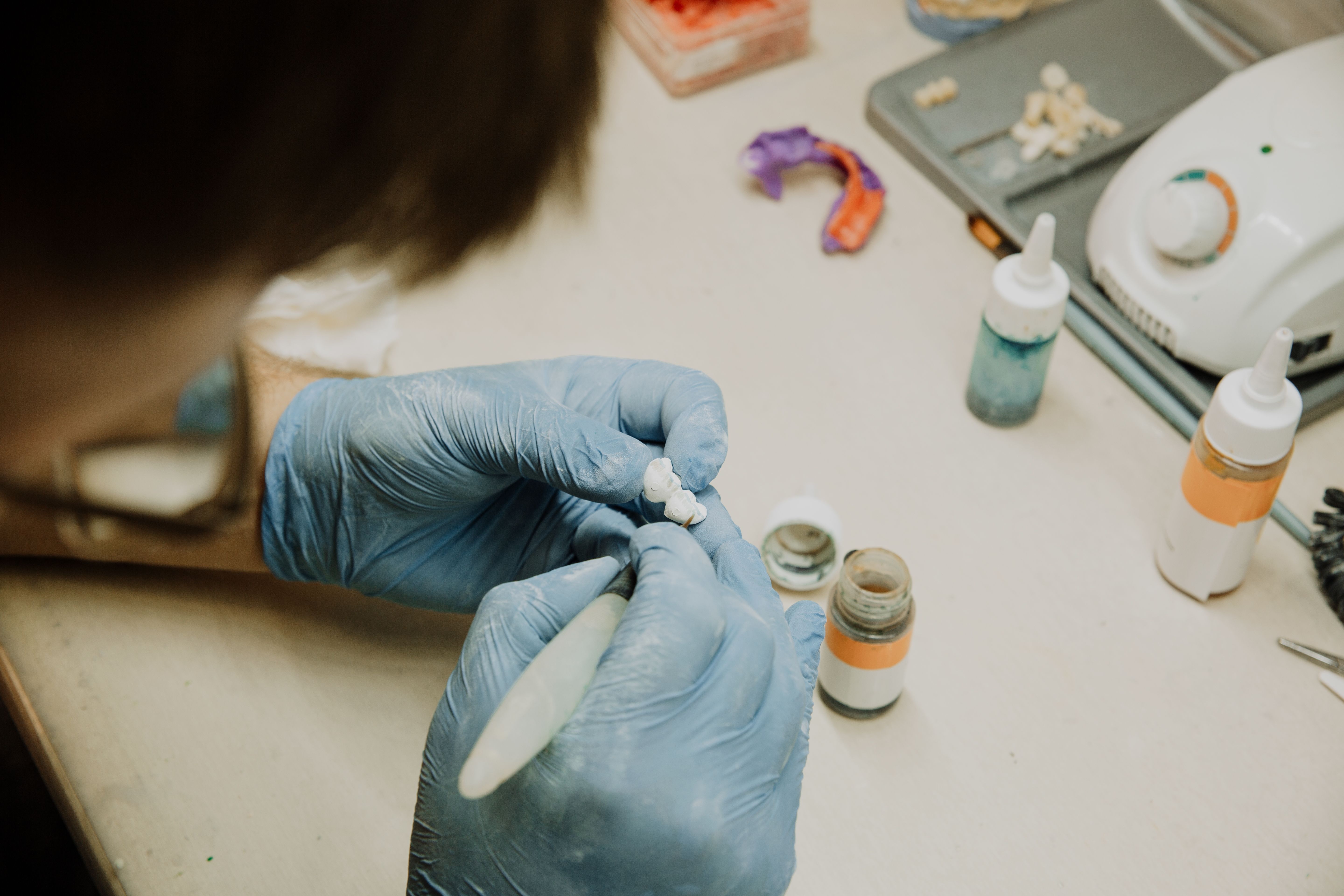
When your dentist prepares a tooth for a crown, the crown itself does not exist yet. Someone has to design it to fit your prepared tooth, bite against the opposing teeth correctly, match your other teeth in colour and shape, and be milled or pressed from an appropriate material.
That is skilled technical work, and it is a separate profession. Dental laboratory technicians train in complete dentures, removable partials, and fixed prosthodontics including inlays, onlays, crowns, and bridges. Your dentist writes a prescription describing what is needed; the technician builds it.
The Standard Model: Prescribe, Package, Wait
In the conventional workflow, an impression or digital scan goes out to a laboratory, the restoration is made over a period of days or weeks, and it comes back for fitting at a second appointment. In between, you usually wear a temporary.
Nothing about that is wrong. It is how most dentistry has been done for decades, and plenty of excellent laboratories work this way. The limitations are practical rather than clinical: transit time, a second appointment, and the fact that any question the technician has about your case has to be answered remotely, often by email or over the phone.
What Changes When the Lab Is Down the Hall
The single biggest difference is not speed. It is that the person designing the restoration and the person placing it can look at the same case, together, while you are still in the building.
A technician who can walk into the operatory, look at your actual teeth under the same light, and see how the restoration seats is working from more information than a technician reading a prescription three states away. Shade, contour, and bite are easier to get right when they can be checked against the patient rather than against a model and a written note.
Same-Day Crowns, Realistically
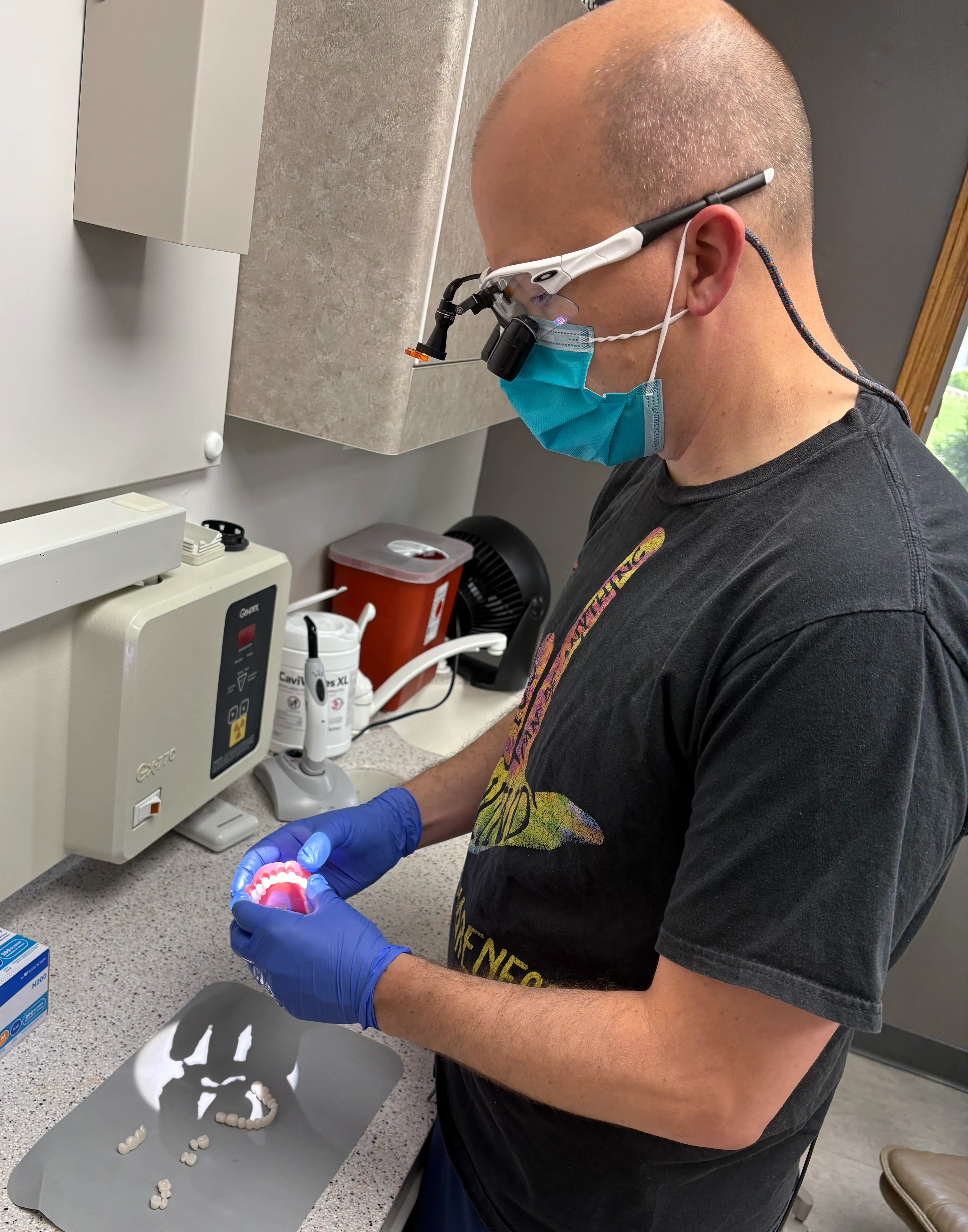
Chairside milling means a crown can be designed from a digital scan and cut from a solid ceramic block in the office. For straightforward cases, that can mean one appointment instead of two, with no temporary in between.
It is worth being accurate about what this does and does not buy you. Research comparing CAD/CAM and conventionally fabricated crowns has found broadly similar clinical outcomes across biological, technical, and esthetic measures, with CAD/CAM restorations showing somewhat more esthetic complications such as marginal discolouration in the studies reviewed.
So the honest claim is convenience and coordination, not superiority. A same-day crown is not a better crown. It is a comparable crown delivered in a single visit, which for many people is the part that actually matters. Our crowns page covers the clinical side.
Why Skipping the Temporary Is Worth Something
Temporary crowns are a reasonable solution to a real problem, but they are the weakest part of the two-visit process. They can loosen, come off at inconvenient moments, leak, and leave the prepared tooth sensitive. Patients are told to avoid certain foods and to floss carefully around them.
Removing that stage removes a set of small risks and a few weeks of being careful. For a front tooth in particular, it also removes several weeks of living with a provisional that does not look quite like the final result.
Digital Scanning Instead of a Tray of Impression Material
In-house fabrication generally starts with an intraoral scan rather than a conventional impression, because the digital file feeds straight into the design software.
That is a benefit in its own right. A systematic review of scanning versus conventional impressions in fixed prosthodontics and implant dentistry found scanning took less chairside time, averaging 12.1 minutes against 16.7 minutes for implant impressions, and that patients preferred it in ten of the eleven studies measuring preference. The reasons given were the things you would expect: taste, gag reflex, difficulty breathing, and anxiety about having to repeat the impression.
The same review found prosthodontic outcomes were broadly similar either way, and noted that accuracy falls as the scanned area gets larger. For single units and quadrants, scanning is excellent. For full-arch work, conventional impressions still have a role.
Shade Matching With the Patient Still There
Colour is where remote fabrication most often falls short, because teeth are not one colour. They vary from the gumline to the edge, they change in different light, and photographs do not reproduce that reliably.
When shade can be assessed with the patient present and the restoration adjusted on site, there is simply more opportunity to get it right before anything is cemented. This matters most for porcelain veneers and front teeth, where being slightly off is immediately visible.
Adjustments and Remakes Without a Second Shipment
Sometimes a restoration needs modifying. The contact with the neighbouring tooth is slightly tight, the bite needs refining, the contour is not quite right.
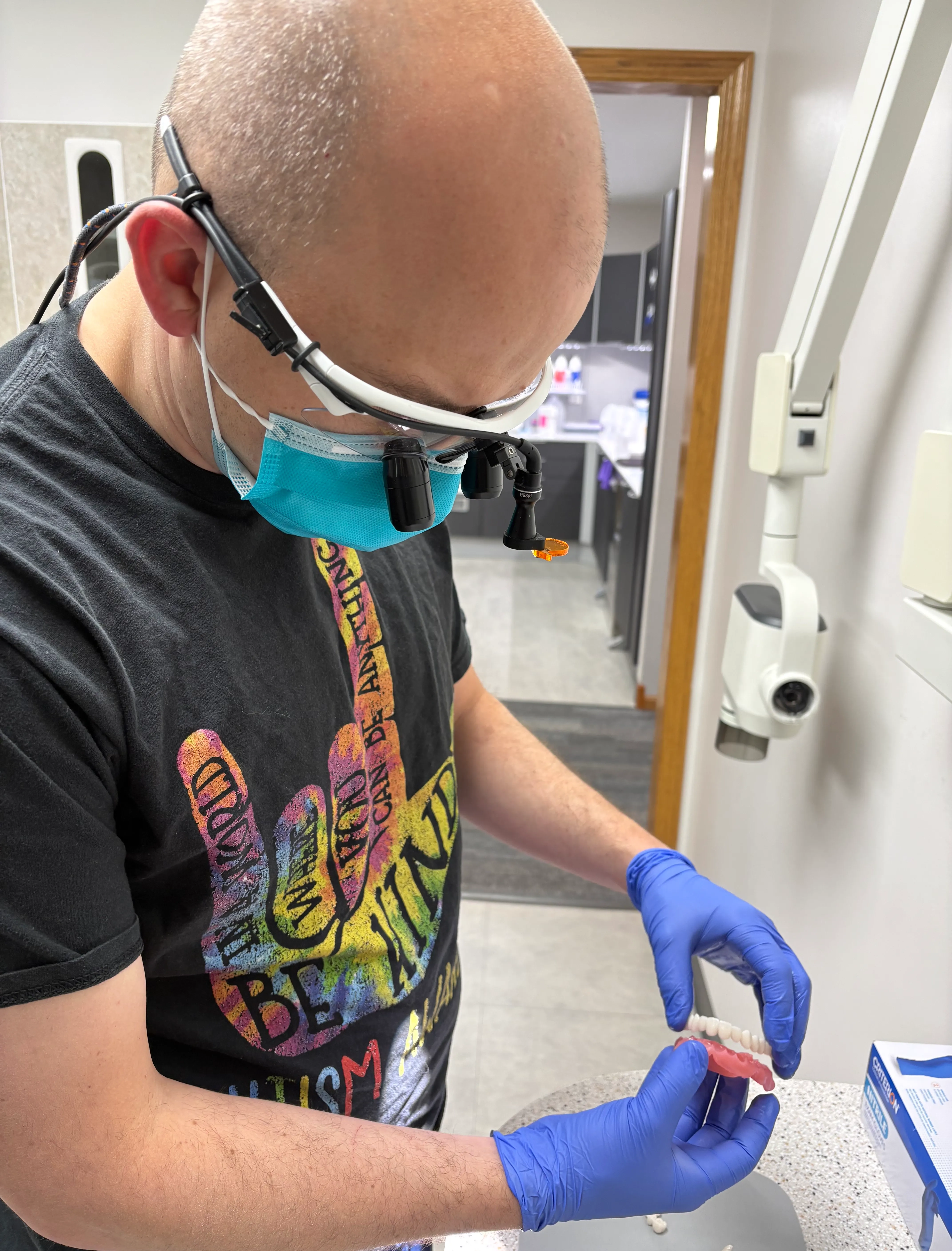
In the conventional model, a remake means packaging the case and sending it back, then waiting again. On site, a small adjustment can often be handled during the same visit. This is the least glamorous advantage of an in-house lab and arguably the most useful one.
Surgical Guides Designed and Printed On Site
For implant cases, a surgical guide is a custom-made template that helps direct the position, angle, and depth of the implant according to a plan made from a 3D scan.
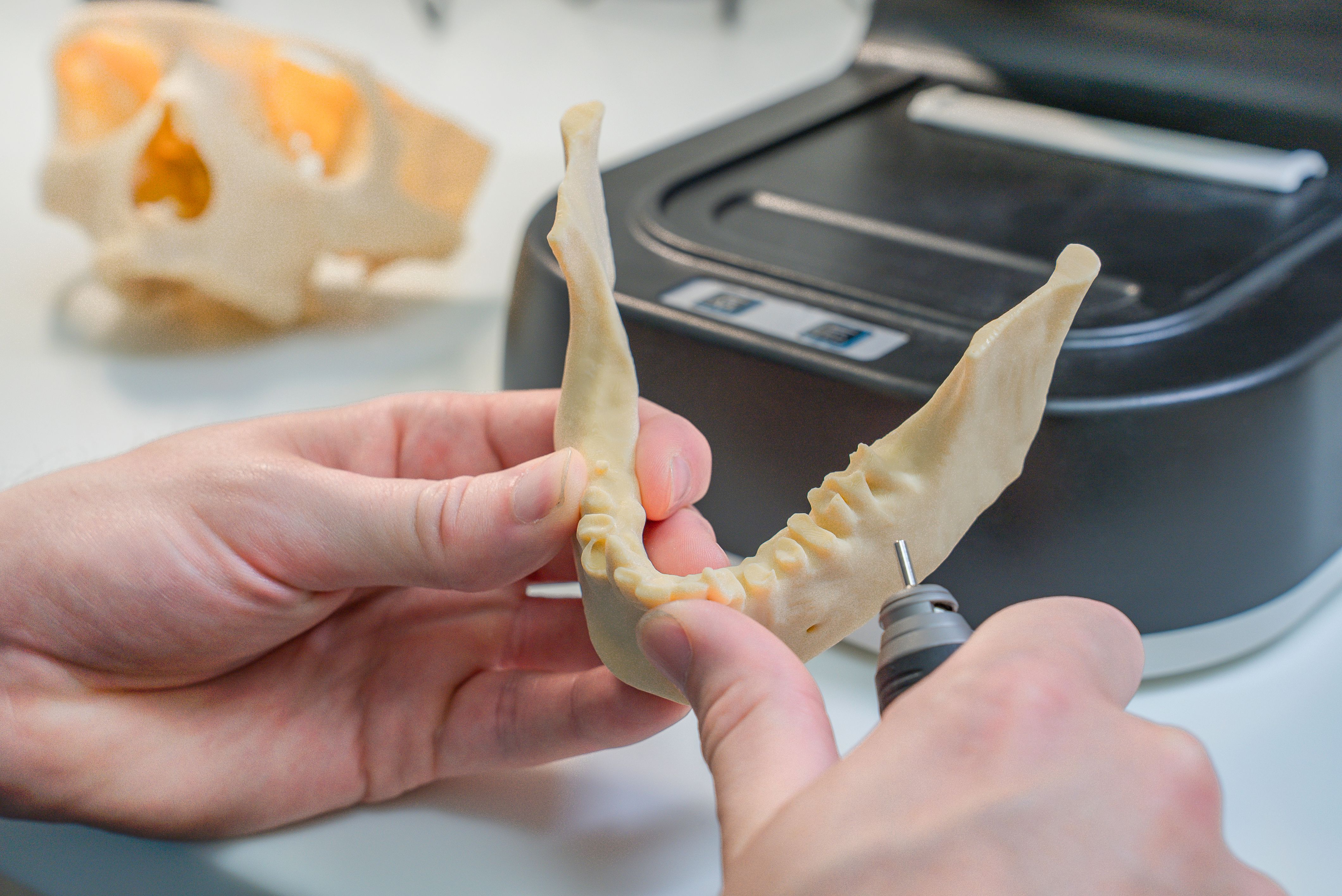
Designing and printing that guide in the office means the clinician who will perform the surgery can review the design before it is produced, and the guide can be printed without waiting on outside turnaround. See our dental implants page for how guided placement works.
Dentures and Removable Work
Removable prosthetics are adjustment-heavy by nature. A new denture usually needs several visits to refine fit and comfort, and each adjustment in the conventional model may mean another trip to the laboratory.
When that work is handled in-house, the cycle between "this spot is sore" and "this has been adjusted" is much shorter. Our dentures page sets out the options.
Knowing Who Made Your Restoration
Here is something most patients do not know. Dental laboratories and technicians are far less regulated than you might assume. The National Board for Certification in Dental Laboratory Technology notes that most state dental practice acts do not regulate or set operating standards for dental labs or technicians, and that domestic laboratories remain unregulated in more than forty states.
Certification exists and is voluntary. Certified Dental Technicians must complete continuing education annually, and Certified Dental Laboratories are assessed on quality assurance and manufacturing practices. But the baseline requirement in most states is thin.
The Board's own position is that dentists and patients should know where their restorations come from, who makes them, and what materials are used. That is a reasonable question to ask of any practice, whether or not it has a lab on site. A practice that fabricates in-house can usually answer it immediately.
What In-House Does Not Mean
It does not mean every restoration is made on site. It does not mean treatment is cheaper, and you should be sceptical of anyone who implies the savings automatically reach you. It does not mean the dentist personally mills your crown between appointments.
It also does not mean faster is always better. A case that needs careful staging should be staged carefully, and having the capability to do something in one visit is not a reason to do it in one visit.
The Honest Limits
Not every case suits chairside fabrication. Complex full-arch work, demanding aesthetic cases, and certain materials are often better handled by a specialist laboratory with equipment and expertise aimed specifically at that work. A good practice with an in-house lab still sends cases out when sending them out is the right call.
Chairside systems also require investment, maintenance, and training, and the results depend on the skill of the people operating them. The equipment is a tool, not a guarantee.
Questions Worth Asking Any Practice
- Where is my restoration being made, and by whom?
- What material will it be made from?
- How many appointments should I expect?
- Will I need a temporary, and for how long?
- If the fit or shade is not right, what happens then, and how long does it take?
- Which cases do you send to an outside laboratory, and why?
These are fair questions anywhere. The answers tell you more about a practice than any list of equipment does.
The Advantage Is Coordination, Not Magic
An in-house lab does not make a crown last longer. What it does is shorten the distance between the person making a restoration and the person it belongs to. Fewer appointments, fewer temporaries, fewer rounds of shipping, and a faster answer when something needs adjusting.
If you are weighing up a practice, ask where the work is made and what happens when something needs changing. If you would like to see how it works here, you can request an appointment and ask to have the lab pointed out while you are in.
References
- National Board for Certification in Dental Laboratory Technology. What Dentists Should Know About Certification.
- Siqueira R, et al. Intraoral scanning reduces procedure time and improves patient comfort in fixed prosthodontics and implant dentistry: a systematic review. Clinical Oral Investigations, 2021;25(12):6517-6531.
- Aswal GS, et al. Clinical Outcomes of CAD/CAM Based and Conventional Full Crowns and Fixed Partial Dentures: A Systematic Review and Meta-Analysis. Cureus, 2023;15(4):e37888.
People Ask
 Dr. Roy Burkhalter, DDS